
Knowledge
Stannous Methanesulfonate: A Deep Dive into Development, Use, and Future Direction
Historical Development
Stannous methanesulfonate began making waves in industrial chemistry in the second half of the 20th century. Before this compound entered the scene, most tin(II) compounds available for plating and electronics relied on legacy chemistries—often sulfate or fluoride-based electrolytes. These options worked, but each had its hurdles: limited solubility, troublesome sludge, or environmental headaches from waste treatment. Methanesulfonic acid and its salts, including stannous methanesulfonate, started shifting the game as plating engineers and chemists sought cleaner and more controllable chemistries, especially for electronics. This search picked up speed in the 1980s with stricter regulations and higher expectations for reliability in circuit production. Research from Japan, Europe, and the US showed that methanesulfonic acid brought impressive solubility and stability—results that matter for high-resolution plating lines. My own time in a surface finishing lab taught me that a smooth plating bath without recurring maintenance issues saves both headaches and money. Watching the adoption of methanesulfonates over the years painted a clear picture: these compounds earned their spot because the industry demanded better control, less waste, and better environmental outcomes.
Product Overview
Stannous methanesulfonate stands as a go-to compound where stable, highly soluble tin(II) is necessary. You find it at the core of many industrial tin electroplating baths, especially for printed circuit boards, connectors, and semiconductors. A clear, colorless, and odorless liquid, it mixes well with water and keeps its stannous ion content stable over time without quickly oxidizing to the less-useful tin(IV). Electroplaters see the value in a compound that lets them tweak process parameters and lay down bright, smooth metallic tin—even in features measured in microns. For anyone troubleshooting a plating shop, the predictable performance of stannous methanesulfonate means fewer surprises and easier adjustments. As a key building block in the broader world of specialty chemicals, its importance pops up in many technical manuals, product catalogues, and research papers alike.
Physical & Chemical Properties
The chemical formula of stannous methanesulfonate is Sn(CH3SO3)2. It carries a molecular weight of about 308.95 g/mol. As a liquid, it boasts excellent solubility in water, giving the electrolyte engineer wider room for formulating plating solutions. This property beats many traditional tin compounds, which form much less concentrated solutions and risk crystallization at lower temperatures. It features a faintly acidic character thanks to the methanesulfonate anion, but does not smell harsh and rarely shows signs of volatility. In the plating laboratory, clear liquids are easier to dose than slurries or suspensions—clean transfer and measurement help keep baths on-spec. Shelf life depends on protection from air and light, as unwanted oxidation turns valuable stannous ions into unusable forms. That’s something I saw play out when a partially capped jug grew cloudy, forcing a full disposal. In practical applications, knowing this compound’s easy-handling nature and solubility helps technicians keep costs in check and reject rates low.
Technical Specifications & Labeling
Suppliers list stannous methanesulfonate as either anhydrous or as a standardized aqueous solution, usually between 20% and 50% by weight. Quality control focuses on tin(II) content, free acid, and impurities such as lead, iron, or copper. Electroplating demands tight limits on these metals, since even a few parts per million can trigger defects or reliability risks in finished parts. Packaging comes in high-density polyethylene drums, with labels mandating UN hazard codes and environmental handling instructions. Product datasheets often stress the need to keep containers sealed, use only clean glass or plastic tools, and avoid mixing with oxidizing agents. Plating chemists learn to check certificates of analysis and batch traceability, tying each drum of electrolyte to quality assurance documents. With good labeling and clear specifications, technical staff can troubleshoot problems faster and stick to regulatory obligations for material handling and waste management.
Preparation Method
Manufacturers create stannous methanesulfonate by directly reacting tin metal with methanesulfonic acid under an inert atmosphere. This method gives better yields and cleaner product than legacy routes relying on tin(II) oxide or tin(II) chloride precursors, where side reactions and impurity pickup pose ongoing challenges. Direct acid-metal reactions also lend themselves to continuous processing, cutting costs and boosting purity. In some plant visits, I’ve watched how critical process control prevents over-oxidation or unwanted by-products from creeping in. By matching the reaction temperature and ratio of reactants, chemists squeeze out the best properties for subsequent use in electronics or surface finishing. Scale-up rarely proves easy; if oxygen or contaminated metal gets into the reactor, whole batches can require scrapping. Plant engineers and quality analysts work hand-in-hand to keep every drum consistent, since customer shops expect baths to behave the same way every run.
Chemical Reactions & Modifications
Stannous methanesulfonate reacts primarily as a tin(II) source. In an electroplating bath, electric current reduces the tin(II) ion onto a substrate, leaving behind the methanesulfonate anion. This compound can also engage in substitution reactions where tighter control of the cation is needed, a useful trait in organic synthesis labs. Overexposure to oxidizers, both chemical and electrochemical, will drive the stannous ion to the less-desirable tin(IV) form, which stops plating and muddies the solution. Modifications on the base compound include blending with additives—antioxidants, grain refiners, surfactants—to tailor the final plating deposit for specific grain structures or hardness. Some patents describe advanced baths where stannous methanesulfonate works in tandem with bismuth or silver sources for specialty coatings. In my experience, chemists value the compound for speed and clarity during plating, but always remain vigilant for slow shifts in pH, oxidation-reduction potential, or bath contaminants. Regular chemical checks keep costs and scrap under control.
Synonyms & Product Names
Over the years, stannous methanesulfonate picked up several synonyms. Chemically, chemists refer to it as tin(II) methanesulfonate or tin bis(methanesulfonate). Many international suppliers list it under trade names, some referencing proprietary stabilizer blends or purity grades for electronics. In technical documents, abbreviations like SnMSA or Sn(MSA)2 pop up. Procurement teams and R&D staff get used to cross-referencing these names to avoid double-ordering or replacing one grade with the wrong one. Trade shows, catalogues, and patents show a mix of IUPAC names and shorter trade names, so the ability to recognize the full family tree of synonyms saves confusion and keeps projects on track.
Safety & Operational Standards
Stannous methanesulfonate, while much safer than some older tin compounds, still deserves respect in handling. The acid character and reactivity with oxidants means that direct skin or eye contact brings risk of irritation. Long-term exposure in poorly ventilated areas can trigger headaches or mild metallic tastes, making local exhaust and gloves a must in shop spaces. Process areas prioritize chemical safety data sheets and rapid cleanup of spills to avoid slippery surfaces. Industrial hygiene programs train workers to spot cloudiness or color changes—signs of contamination or error—well before a bath goes out of spec. Storage hinges on sealed, air-free containers well away from strong oxidizers. Equipment designs favor non-reactive glass or plastic piping to dodge unwanted catalysis or breakdown. Facility audits, both internal and by regulators, check documentation, labeling, and spill response plans. A good safety program treats the compound with enough caution to prevent accidents but avoids over-complicated measures that slow productivity.
Application Area
The largest slice of global stannous methanesulfonate heads straight into electronics. Printed circuit boards get a layer of pure tin to guard copper traces against corrosion and boost solderability. Connectors, semiconductor contacts, and flat-panel displays all rely on reliable tin deposits—which means that quality begins with a well-managed stannous source. Photovoltaics and specialty alloys add to the industrial appetite. Some specialty chemical syntheses draw on the reducing power and solubility of this organotin compound, though in smaller quantities. Every time an electronics OEM asks for more reliable lead-free products, demand rises for chemistries built around stannous methanesulfonate. During the smartphone and green energy booms, manufacturers put heavy stress on suppliers for consistent quality, tight impurity control, and flexible logistics. Regulatory pressure to phase out lead in electronics strengthened the market for this compound, as alternatives to tin-lead solder alloys gained steam.
Research & Development
Ongoing R&D effort surrounds stannous methanesulfonate. Universities and industrial labs investigate better stabilizers, antioxidants, and plating additives to push deposit smoothness, prevent whisker growth, and eliminate tiny pinholes that can blow up in reliability tests. Researchers still debate the best operating window for pH, temperature, and current density in next-generation microelectronics, since even minor parameter drifts can wreck yields. Newer topics on the research agenda include recycling spent plating baths and lowering overall tin usage, both for cost and sustainability. Green chemistry teams look for ways to make the manufacturing process safer, cutting corrosive by-products and improving the purity of both product and waste streams. Collaboration between chemistry departments and electronics firms brings about process tweaks that feed back into commercial bath designs. As supply chains globalize, research also focuses on long-distance shipment stability and regional regulations for hazard labeling. Practical, bench-level innovations most often flow directly from frustrations faced in real plating shops—unplanned oxidation, drifting deposit properties, or the push for higher throughput always nudge scientists and engineers back to the drawing board.
Toxicity Research
Scientists pay close attention to the health and environmental profile of tin compounds. Stannous methanesulfonate, compared to many other organometallics, shows moderate toxicity if ingested or inhaled, but does not persist in the human body as stubbornly as some heavy metals. Safety tests point to local irritation at high exposures, highlighting the need for skin and eye protection. In waste treatment, concern centers on tin accumulation if plating sludge escapes proper disposal. Environmental chemists track how stannous and methanesulfonate ions break down in soil and water. Studies to date find that, with robust wastewater treatment and containment, ecological risk stays moderate, but regulators often push for more closure in containment and disposal practices. Workers in the electronics value chain benefit from substitution of more toxic tin sources with methanesulfonate-based baths. Nonetheless, every spill, line leak, or disposal slip-up remains a reminder that industrial chemistry requires ongoing vigilance and improvement in risk management. My experience with environmental monitoring teams showed the value of regular air and discharge testing, since lagging behind on these checks can trigger severity in both compliance fines and real-world health impacts.
Future Prospects
The outlook for stannous methanesulfonate stays bright as electronics miniaturization and green energy rollouts continue to reshape advanced manufacturing. Thin, high-purity tin coatings enable denser, more complex printed circuit boards and connectors, carving out a long-term role for this compound in next-generation device architectures. Industry turn to lead-free and eco-friendly materials strengthens interest in organotin chemistry that brings low toxicity and good processability. Automated, closed-loop plating lines give suppliers new requirements for drum stability, online controls, and digital traceability. Research on new stabilizers and advanced bath management keeps pushing the limits on production yield and product performance. With regulatory pressure always evolving, compound manufacturers must keep one eye on sustainability metrics—carbon footprint, recyclability, and new disposal standards. Ongoing collaboration across chemistry, engineering, and environmental health teams offers opportunities to cut waste, catch emerging risks, and continue supporting safe, high-performance electronics for the next wave of global technology.
The Stuff Behind the Circuit Board Shine
Walking into any tech store, it’s easy to forget that so much of what makes our gadgets tick comes down to thin layers of metal. Not the kind you cut with a hacksaw, but so thin you need a microscope just to spot them. Creating these layers—especially tin—calls for stannous methanesulfonate. While the name doesn’t exactly roll off the tongue, the stuff itself has carved out a niche where reliability and results rule.
How the Electronics World Relies on Stannous Methanesulfonate
Printed circuit boards can’t do their job without tiny metal pathways, and many of those start from tin deposits. That’s where stannous methanesulfonate comes in. Plating with it, engineers get better control over their coatings. The solution lets them lay down tin on copper surfaces quickly, even at room temperature, and makes sure every corner and crevice gets fed. No one wants a phone or a laptop failing because a connector corroded, and a well-plated board holds up under stress.
Lead-free soldering matters more than ever, given stricter rules in Europe and beyond that ban a lot of lead use in electronics. The combination of tin with stannous methanesulfonate covers this base. Engineers can plate a reliable layer of pure tin, making connections less likely to grow whiskers, which are tiny metal tendrils that can short out circuits. The move to pure tin plating owes plenty to this chemistry.
Cleaner, Safer Processes for Workers and the Environment
Other tin solutions, like stannous sulfate or stannous chloride, aren’t as easy to manage. They can leave behind stubborn residues and require tough balancing acts to keep things running. Stannous methanesulfonate stands apart because it mixes easily in water, skips the harsh acids, and generates less waste. Maintenance crews don’t have to worry so much about hazardous fumes or crusty build-up in their lines. It’s these practical, day-to-day advantages that help explain why so many factories choose it.
Stepping Into Energy Storage and Solar
Batteries keep getting pressed for more power without growing heavier. To squeeze in extra capacity, companies are exploring tin compounds as alternatives to graphite in certain battery types. Stannous methanesulfonate feeds into these experiments with its ability to deposit tin evenly on battery anodes. No wild guesswork—just steady, dependable performance that researchers can track from one trial to the next. Scientists are still working out the big-picture role, but it’s clear the material offers a direct way to improve longevity and safety.
What Could Make It Even Better?
No chemical solution runs without hiccups. Cost poses a challenge, especially for smaller firms trying to keep up with big players. Stannous methanesulfonate doesn’t sell for pocket change, and price swings can throw budgets off track. Another issue comes from the need to recycle leftover plating solutions. Getting the most out of each batch means filtering out contaminants and finding smart ways to reuse or safely dispose of waste.
Bringing in advanced monitoring tech could give real-time snapshots of plating bath health, which keeps quality up and cuts over-use. More research on recovery and recycling processes—think turning spent solution back into usable chemicals—could ease worries about supply and cost in the future. Sharing what works between companies would help the industry learn faster and head off common pitfalls.
Why It Deserves Attention
As long as digital life keeps marching forward, demand for reliable connections and safer tech isn’t slowing down. Stannous methanesulfonate has taken on a quiet but crucial role in smoothing the way, both for folks designing tomorrow’s devices and the people building them today. Better processes and smarter use can bring down costs and reduce waste, which matters to everyone from engineers on the line to the person holding a new smartphone.
Chemistry at the Core: Everyday Impact
If you’re working around electroplating or electronics manufacturing, there’s a high chance you’ve bumped into the name Stannous Methanesulfonate. In the world of tin-based plating, this compound shows up constantly. People sometimes get tripped up by the long name, but the principle is simple once you break it down.
Breaking Down Stannous Methanesulfonate: The Basics
Stannous stands for tin in its +2 oxidation state, which is important because tin can switch between +2 and +4 pretty easily. Methanesulfonate refers to the anion derived from methanesulfonic acid. The formula shows just how these parts lock together: Sn(CH3SO3)2.
Sn represents stannous (tin, +2), and each methanesulfonate group is CH3SO3-. Two of those balance the positive charge from the tin, landing you at the neat formula above. Nothing too fancy, but that’s what makes chemistry satisfying—small changes in molecular makeup give a compound a whole new range of uses and properties.
Real World — More Than a Formula
Tossing chemical formulas around in class or at work, it’s easy to forget every compound shapes someone's job or field. I used to help troubleshoot plating solutions for circuit board manufacturing. Stannous Methanesulfonate would come up all the time. It's water-soluble, works at room temperature, and doesn't throw off tons of environmental toxins, unlike some older plating options.
Switching to this compound reduced lead contamination, which always kept local environmental agencies less anxious and shop air safer to breathe. On the production side, it cut down waste cleanup costs. I’ve seen plating lines run smoother, finishers report fewer headaches, and audit teams smile a little more—all because someone picked the right compound for the job.
Connecting Safety and Use
Workplace safety depends on understanding exactly what’s in your process tank. Stannous Methanesulfonate plays well with the right additives and doesn’t release the corrosive fumes some alternatives do. This builds trust between workers and management, especially when you bring concrete health data to team meetings.
In my experience, you avoid a lot of employee turnover by swapping out—for example—hazardous stannous chloride solutions and moving toward methanesulfonate instead. Lab results back this up. Safety data from regulatory bodies like OSHA points out fewer hazardous decomposition products. That makes a difference in daily operations and long-term risk audits.
Looking Beyond Just a Formula
Knowing enough chemistry to see past the label means you get to make smarter choices. Stannous Methanesulfonate may sound academic at first, but for anyone in manufacturing, electronics, or research, its formula—Sn(CH3SO3)2—stands for a safer, more reliable way to put metal where it belongs. Industry keeps moving forward through decisions like these, with each compound building up better practices and healthier jobs.
Understanding What We’re Dealing With
Stannous methanesulfonate often plays a crucial part in tin plating for electronics, building semiconductors, and running surface finishing shops. Most people working around this compound already know it brings both benefits and hazards. Many labs depend on it for reliable electroplating, but anyone with first-hand experience will say the risks of mishandling are real. Touching or breathing it in by accident never ends well. A friend once told me about a storage room disaster that left employees choking, all due to a leaking chemical drum.
Why Proper Storage Matters
Stannous methanesulfonate breaks down if stored wrong. Heat, light, and contact with air speed up its degradation. When this compound goes off, you end up with wasted supplies, unpredictable plating results, and in some cases, health hazards. The Environmental Protection Agency and OSHA place strict guidelines for a reason. Overlooking them can draw fines or injuries. Practically speaking, this boils down to a few clear rules.
Cool, Dry Storage Always Wins
Any professional responsible for chemical stocks would want to keep stannous methanesulfonate in a spot free from direct sunlight or big temperature swings. Warm storage rooms trigger decomposition, which releases toxic tin fumes and causes loss of plating efficiency. Moisture complicates things further by promoting hydrolysis and turning valuable contents into useless sludge. Air conditioning never seems like an extravagance here. It’s the simplest safety net for protecting chemical quality and the people on site.
Sealed, Non-Reactive Containers
Every chemical warehouse crew knows not all containers offer the same protection. Stannous methanesulfonate reacts with metals and breaks down if it contacts steel or aluminum. Polyethylene and glass containers handle the task well. Tightly fitting lids are a must, since oxygen and water vapor will creep in and start corrosion or create pressure inside the drum. Regular inspections might feel tedious, but finding crusted leaks in time saves thousands in lost material and weekly cleaning headaches.
Sensible Placement: Away from Incompatible Substances
Mixing this compound with strong oxidizers or acids can set off violent reactions. Clear labeling and well-placed shelving cut down on accidental mix-ups. If your storage room also holds peroxides or mineral acids, spacing matters even more. I’ve seen one spill force an entire lab shutdown because someone had left an open bottle near incompatible chemicals. Segregating chemicals by danger class remains standard practice in any trusted company because it works.
Eye on the Future: Emergency Preparedness
No system is perfect. Spills will happen, so planning makes all the difference. Every facility should organize spill kits, safety showers, and basic ventilation around storage areas. Staff training never finishes—annual refreshers keep everyone sharp on what to do if a drum leaks or breaks. In one past job, quarterly drills reduced panic and made response times far quicker when a real incident hit.
Transparency, Responsibility, and Respect for Chemicals
Documented procedures, visible inventories, and open communication between procurement and safety teams create trust. This might sound straightforward, but a slip here sets off disaster. Nothing builds credibility like taking every precaution, knowing employees’ well-being and the company’s reputation both hang in the balance. Proper storage for stannous methanesulfonate isn’t just a box ticking exercise—it’s the backbone of any responsible operation that values safety and quality over shortcuts.
Looking at the Facts
I’ve spent years around chemicals, both in school and in industrial settings, so questions about toxicity and hazard feel close to home. Stannous methanesulfonate, common in the world of electroplating and electronics, stands out because people think of “tin” and often imagine something simple or safe. That’s not always the case when chemical reactions get involved. This compound usually appears as a colorless to pale yellow liquid. Seeing a chemical like this, it’s easy to overlook what’s underneath—its risks and its proper handling requirements.
Stannous methanesulfonate contains tin in a +2 oxidation state, paired with methanesulfonic acid. Chemists use it in plating because it dissolves well and allows for a smooth even coating. But anyone who has worked with methanesulfonic acid knows: spilled on skin, it burns. Inhaled, it irritates nasal passages and lungs. That's before considering what happens if it’s swallowed or gets in your eyes.
Risks at Work and in the Lab
Some people believe that tin compounds are low risk. That idea may come from tin’s role in food cans, or old tales about pewter mugs. Reality in an industrial setting looks different. Studies in toxicology and workplace health say inhaling or ingesting stannous compounds over a long time can build up in organs. Workers may run into respiratory or skin irritation, headache, and nausea if ventilation is poor or if spills go unchecked. I’ve seen enough workplace accidents to know that ignoring even simple contact rules leads to bigger problems down the line.
Material Safety Data Sheets label this chemical as corrosive. A splash on bare skin or in eyes means pain and possible tissue damage. Gloves and tight-fitting goggles matter, not because safety pros love spending money but because acid burns don’t just heal with time. In some cases, people develop sensitivities or allergies. Symptoms such as rashes, coughing fits, and asthma flare-ups show up when exposure repeats and builds up over time.
Handling the Risks
Safety with stannous methanesulfonate comes down to habits and equipment. My mentors in the lab used to say you don’t “get brave” around acids. Instead, you double down on fume hoods, face shields, and acid-resistant gloves. Regular training, clear signage, and spill kits matter. Some think labeling seems like overkill, but a misplaced bottle on a shelf can create trouble fast. In plating shops, proper ventilation cuts down on airborne risk. Washing up before lunch keeps residues far from sandwiches and coffee cups.
Waste disposal counts as much as personal safety. Pouring leftover stannous methanesulfonate down the drain doesn’t just breach the law, it damages wildlife and water sources. Waste handlers know that treating or collecting this chemical for proper processing matters for everyone’s health outside the plant, too. Regulatory bodies, from the EPA in the U.S. to their European counterparts, have set rules for a reason. Inspections—sometimes seen as a hassle—end up saving lives and reputations.
Safer Alternatives?
Some researchers have searched for alternative tin salts, or for new plating techniques that either cut down on methanesulfonic acid or use less risky reagents. The road to real replacement is slow. Until then, respect for the risks remains the real safeguard. Adequate training, regular medical check-ups for workers, and a commitment to safety culture form the backbone of responsible chemical use.
Tin Plating: More Than Just Shine
Electronics rely on precise and reliable metal finishing. Every circuit board, battery terminal, and connector supports some invisible battle against corrosion. Factories across the globe use stannous methanesulfonate to put a protective, conductive tin layer onto copper and other metals. Old-school methods using tin salts or tin sulfate struggle with sediment and low solubility. This compound dissolves well in methanesulfonic acid and keeps plating baths clean and long-lasting. Manufacturers appreciate how it lays down stable coatings without the headache of heavy waste, odd colors, or fragile results.
Printed Circuit Boards: Consistency Counts
I’ve spent hours troubleshooting weird solder joints and intermittent open circuits. As electronics have shrunk, the margin for error evaporates. Factories count on stannous methanesulfonate for tin deposition on printed circuit boards, especially during the electroplating steps. Thin, even layers improve solderability. This gives circuit boards a fighting chance against moisture and time. Plating baths need regular checks, but the actual chemical rarely causes trouble compared to some others I’ve seen.
Data Storage and Magnetic Devices
Modern data doesn’t stay on a desktop anymore. Cloud servers fill up fast, and those racks need dependable hard drives. Stannous methanesulfonate enters the picture during the production of thin magnetic films, especially in technologies like MRAM (magnetic random access memory) or hard drive platters. Industrial researchers favor this solution because it builds layers of high-purity tin without introducing stray elements that throw off the tiny, sensitive read/write heads.
Renewables and Solar Cell Manufacturing
Solar panels might seem far removed from tin chemistry, but stannous methanesulfonate gets involved in coating contact fingers and busbars. Layer thickness and purity influence panel performance and efficiency. Producing solar tech with this chemical makes it easier to recycle waste streams and cut back on hazardous byproducts. Tin layers applied this way bond tightly to silicon without flaking, keeping production lines humming and reducing downtime for maintenance.
Electronics Assembly (Soldering and Coatings)
Anyone who has reflowed a circuit board knows the dreaded “cold joint.” The challenge comes down to surface prep, and tin plating with stannous methanesulfonate solves more problems than it causes. Manufacturers include this chemical in prep tanks, especially in automated assembly lines, to create solder-friendly surfaces on metals like copper and brass. Consistent plated layers cut down on rejects in everything from consumer gadgets to medical implants, where reliability is non-negotiable.
Meeting Environmental and Safety Rules
Regulations keep getting tougher on what goes down the drain. Older tin-plating chemicals contribute waste—often with heavy metals or persistent organics. Stannous methanesulfonate does not produce much toxic sludge and behaves predictably. Factories save on disposal and avoid downtime for surprise safety inspections. With groups like the EPA and REACH watching industrial waste, any process that reduces environmental headaches makes life easier for workers and local communities.
Looking Forward
Tin chemistry shapes much of the electronics and renewable energy that everyone depends on. Reliable sources of stannous methanesulfonate, clear handling procedures, and well-trained teams make the difference between smooth production and risky recalls. Keeping up with safety data and best practices in handling keeps workers safe and products trustworthy. Switching to cleaner, consistent chemicals keeps costs lower and quality higher, giving manufacturers room to innovate—without looking over their shoulders at regulatory fallout.
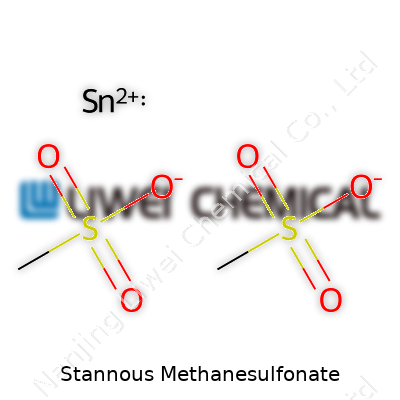
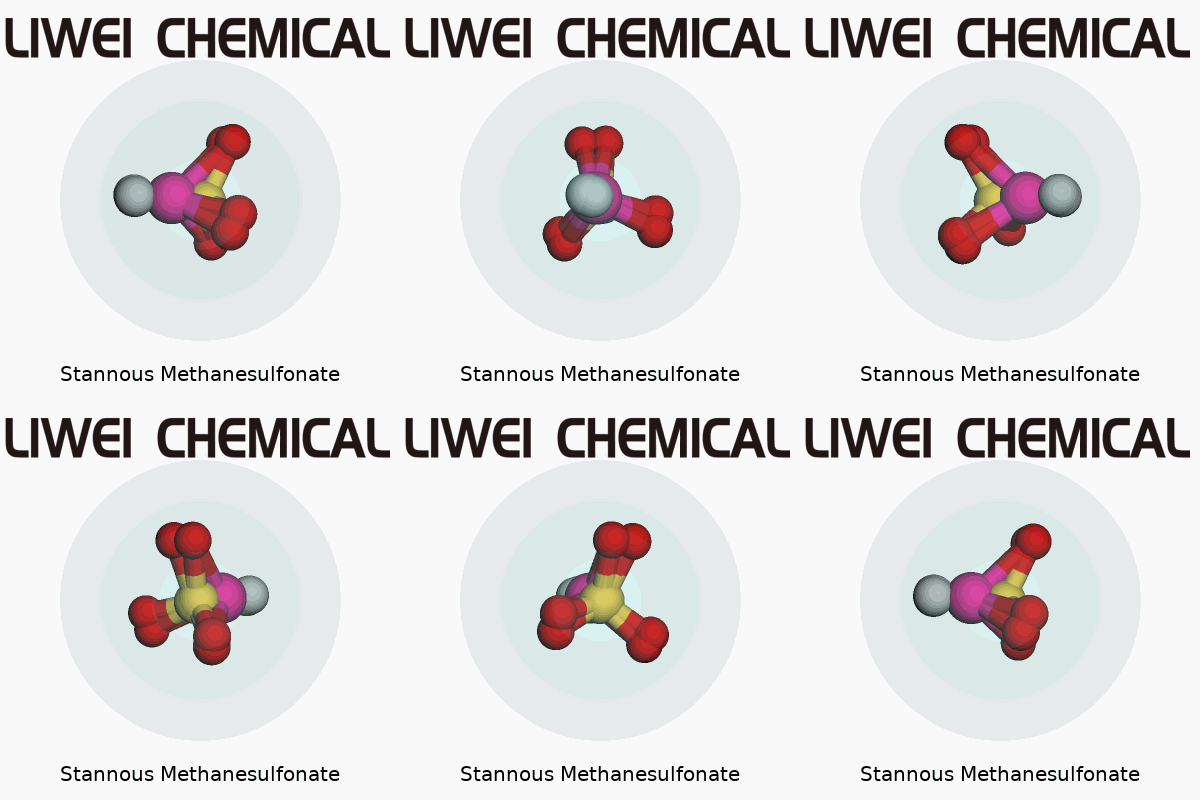
| Names | |
| Preferred IUPAC name | tin(II) methanesulfonate |
| Other names |
Methanesulfonic acid, tin(2+) salt
Stannous methanesulfonate Tin(II) methanesulfonate Methanesulfonic acid tin(II) salt |
| Pronunciation | /ˈstæ.nəs mɛˌθeɪnˈsʌl.fəˌneɪt/ |
| Identifiers | |
| CAS Number | 63393-34-4 |
| Beilstein Reference | 3585957 |
| ChEBI | CHEBI:78010 |
| ChEMBL | CHEMBL4290492 |
| ChemSpider | 21171416 |
| DrugBank | DB11375 |
| ECHA InfoCard | 100.036.734 |
| EC Number | 233-296-7 |
| Gmelin Reference | 87849 |
| KEGG | C18615 |
| MeSH | D017983 |
| PubChem CID | 16211013 |
| RTECS number | XF8225000 |
| UNII | 2E3H0LN6L9 |
| UN number | UN3267 |
| Properties | |
| Chemical formula | Sn(CH3SO3)2 |
| Molar mass | 284.83 g/mol |
| Appearance | Colorless transparent liquid |
| Odor | Odorless |
| Density | 1.95 g/cm³ |
| Solubility in water | Soluble |
| log P | -2.1 |
| Vapor pressure | <0.01 mmHg (20 °C) |
| Acidity (pKa) | 2.0 |
| Basicity (pKb) | 9.5 |
| Magnetic susceptibility (χ) | -7.2×10⁻⁶ cm³/mol |
| Refractive index (nD) | 1.430 |
| Viscosity | 20-40 cP |
| Dipole moment | 2.15 D |
| Thermochemistry | |
| Std molar entropy (S⦵298) | 151.6 J·mol⁻¹·K⁻¹ |
| Std enthalpy of formation (ΔfH⦵298) | -770.6 kJ/mol |
| Pharmacology | |
| ATC code | C05CB04 |
| Hazards | |
| Main hazards | Harmful if swallowed. Causes skin irritation. Causes serious eye irritation. May cause respiratory irritation. |
| GHS labelling | GHS02, GHS07, GHS08 |
| Pictograms | GHS05,GHS07 |
| Signal word | Warning |
| Hazard statements | H302: Harmful if swallowed. H315: Causes skin irritation. H319: Causes serious eye irritation. H335: May cause respiratory irritation. |
| Precautionary statements | P264, P280, P301+P312, P302+P352, P305+P351+P338, P310, P330, P501 |
| NFPA 704 (fire diamond) | 2-0-0 |
| Lethal dose or concentration | LD50 Oral Rat 1320 mg/kg |
| LD50 (median dose) | LD50 Oral Rat >2000 mg/kg |
| NIOSH | WI9950000 |
| PEL (Permissible) | Not established |
| REL (Recommended) | 5.0 g/L |
| Related compounds | |
| Related compounds |
Stannous sulfate
Stannous chloride Stannic chloride Methanesulfonic acid Tin(II) oxide |


